Why Web3 Projects Fail: The Psychology of Trust in Crypto

Need effective Web3 marketing?
Get on a free strategy call with Disence
We've helped 120+ Web3 teams launch effective KOL campaigns, build engaged communities, and acquire long-term users. Get 30 minutes of clarity without a pitch.
Book a free strategy call →No commitment · We usually respond within 24h.
Why Trust Is the Real Differentiator
Every week, dozens of new Web3 projects launch and many of them are indeed sound technically, some have genuinely innovative tokenomics, battle-tested smart contracts audited by security firms, and teams with real credentials. Still, most likely you will find them dead within six months.
Meanwhile, other projects, sometimes with less sophisticated tech, attract tens of thousands of users, raise serious capital, and build communities that survive market downturns. The difference is rarely the product. The real difference is trust in Web3.
This isn't a soft, unmeasurable idea. Trust is a behavioral economics phenomenon that directly determines whether users hold, buy, or walk away. According to research published by Nielsen, 88% of people trust recommendations from peers over any form of brand advertising. In crypto, where the average user has been burned at least once, this effect is amplified dramatically. Skepticism is the default setting. As a Web3 project, you earn credibility by consistently doing the right things.
Understanding the psychology of trust doesn't just help you retain users. It helps you acquire them. The projects that explode are the ones that have deliberately engineered trust into their marketing and communication strategy from day one.
The 5 Psychological Triggers That Drive Trust in Crypto
1. Social Proof
Humans are wired to look to others before making decisions in uncertain environments and crypto is the ultimate uncertain environment. When a user lands on your project page, the first thing their brain registers isn't your whitepaper, it's whether other credible people are already involved.
Social proof in Web3 manifests as KOL endorsements, visible community size, transparent on-chain metrics, and recognizable backers. A project with 40,000 active Discord members signals something a 200-page litepaper never can: other people already took the risk and decided to stay.
2. Authority
Projects with anonymous teams consistently underperform in retention. This isn't always because of scam risk, it's because anonymity removes accountability, and accountability is the foundation of authority. When team members attach their faces along with the links on LinkedIn, a verifiable track record, and a professional background to a project, perceived legitimacy increases significantly.
Doxxed founders who speak at conferences, publish thought leadership, and engage publicly create an authority signal that no amount of paid advertising can replicate. This is why Web3 project credibility is increasingly built on personal brand as much as product quality.
3. Consistency
Projects that post their updates consistently and build in public, while sharing everything about their journey (weekly updates, transparent roadmaps, public postmortems when things go wrong) compound credibility over time. Projects that only surface when they have something to sell create cognitive dissonance. Users start to feel marketed at rather than included in.
Consistency also applies to messaging. If your Twitter tone, your Telegram updates, and your official announcements all feel like they come from different organizations, users notice brand coherence is a trust signal.

4. Transparency
The Web3 community has developed an extraordinary collective intelligence for detecting dishonesty. Vague tokenomics, opaque treasury management, and evasive answers to tough questions trigger alarm signals instantly, often before the mainstream press catches up. Projects like FTX collapsed in part because on-chain analysts and community researchers surfaced discrepancies the company refused to address directly.
Transparency doesn't require sharing everything, it requires sharing enough to let your community verify claims, track progress, and hold leadership accountable. That vulnerability is counterintuitively one of the most powerful trust-building tools available.
5. Familiarity
Robert Zajonc's "mere exposure effect" is one of the most replicated findings in psychology: people develop preferences for things simply because they're familiar with them.
In Web3 marketing strategy, this translates directly into multi-channel presence. A user who sees your project on YouTube, then on Twitter, then hears it mentioned in a Telegram group they trust, and finally lands on your site after a podcast reference, that user arrives with a fundamentally different psychological posture than someone seeing your project for the first time via a cold ad.
This is why the best crypto launch marketing doesn't rely on a single channel or a single activation moment. It engineers repeated, credible touchpoints across the platforms where your target audience already spends time.
Why Web3 Projects Fail: The Trust Breakdown Pattern
If you map the lifecycle of failed Web3 projects, you can see that it rarely starts with a scam. It starts with a trust gap that compounds over time.
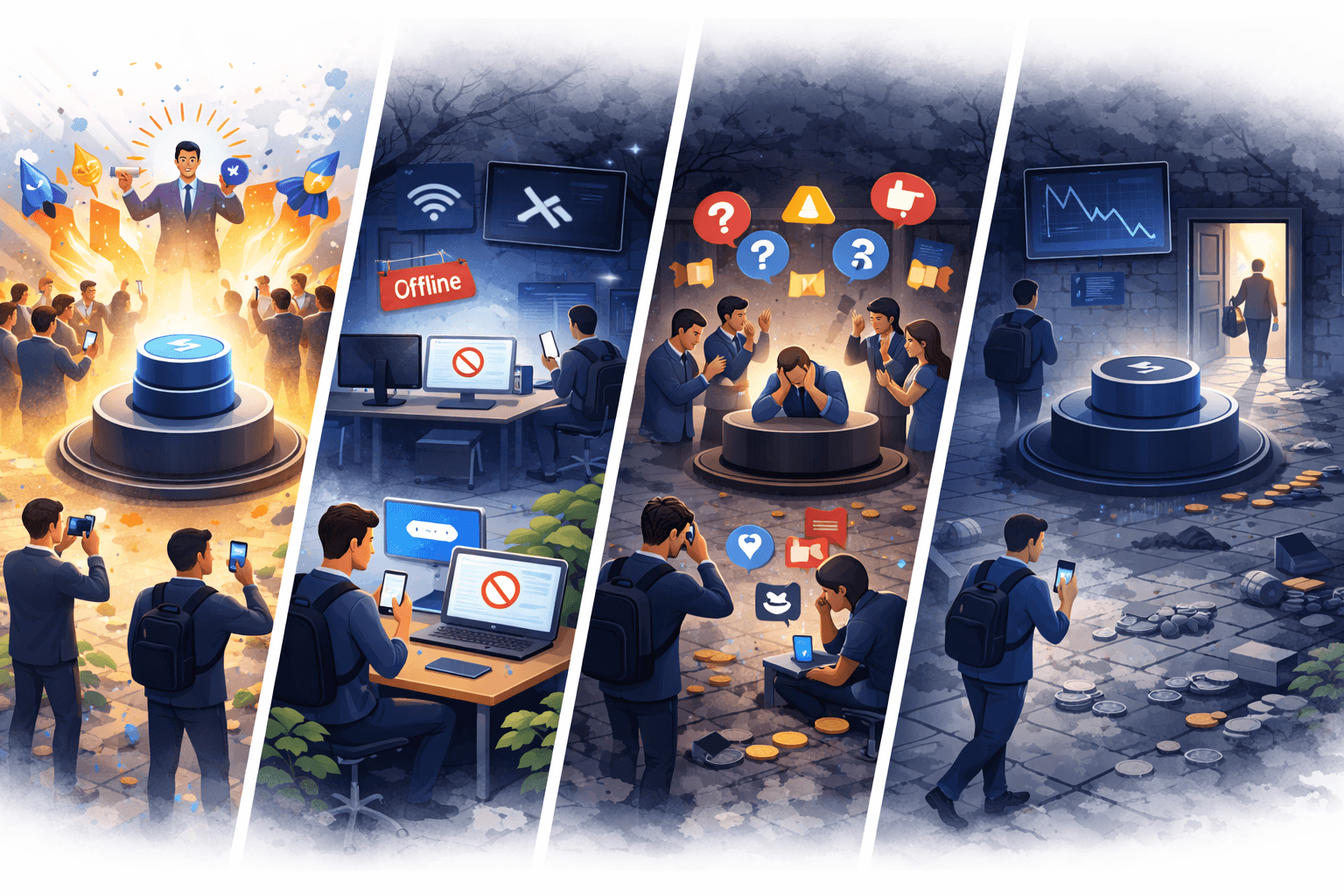
Stage 1: Overpromise at launch.
Aggressive claims, unrealistic timelines, and hype-heavy marketing generate initial attention but set expectations the project can't meet.
Stage 2: Silence during adversity.
When markets turn or development slows, the project team goes quiet. The absence of communication is interpreted by experienced Web3 users as a warning sign.
Stage 3: Community erosion.
Early believers start to question their conviction. Social channels become dominated by FUD (Fear, Uncertainty, Doubt). The project team's failure to respond with transparency accelerates the spiral.
Stage 4: Liquidity exit.
Without trust to anchor holders, price pressure intensifies. The community that wasn't properly cultivated doesn't hold through the difficulty.
The antidote to this pattern isn't better technology, it's a deliberate Web3 marketing strategy built around trust architecture, establishing credibility signals before launch, maintaining communication discipline through volatility, and building community loyalty that doesn't depend on price action.
For a deeper look at how this connects to your go-to-market planning, read our guide: The Web3 GTM Strategy Every Project Needs to Win in 2026.
The Trust Funnel
Think of trust-building as a conversion funnel with four stages:
Awareness → Recognition → Conviction → Advocacy
Most Web3 marketing projects focus almost entirely on Awareness, impressions, reach, follower counts. But awareness without recognition is noise. Recognition without conviction doesn't convert, and conviction without advocacy means you're continuously refilling a leaky bucket.
The projects that dominate their narrative move users through all four stages by layering trust signals:
At the Awareness stage: consistent KOL presence, earned media, and community activity create familiarity.
At the Recognition stage: thought leadership content, transparent communication, and clear utility positioning build authority.
At the Conviction stage: verifiable metrics, community testimonials, audits, and responsive leadership convert skeptics.
At the Advocacy stage: genuine community ownership of the narrative turns holders into marketers.
When this funnel is working, organic growth becomes self-reinforcing. Users who trust a project at the conviction level will actively recruit others, at zero cost to the project.
How KOLs Activate Trust at Scale
Key Opinion Leaders (KOLs) are the most efficient trust accelerators available to Web3 projects today. The reason is psychological: KOLs serve as trusted third-party validators. When a respected voice in the crypto community endorses a project, especially one with a history of honest recommendations, it activates the social proof and authority signals simultaneously.
A 2024 study found that 61% of crypto buyers trust KOL recommendations more than traditional advertising. But here's the critical nuance: this only works when the KOL relationship is authentic and strategically targeted.

Spray-and-pray KOL campaigns, paying dozens of mid-tier accounts for identical scripted posts actively damage trust. Communities can identify inauthentic activation immediately, and it signals that a project is buying credibility rather than earning it.
Effective KOL marketing for crypto requires matching influencer profile to audience segment, briefing KOLs with genuine narrative context rather than promotional scripts, and sequencing activations across the user journey rather than concentrating everything at launch.
To understand where most projects go wrong here, read: Why Most Web3 KOL Marketing Fails (And How to Fix It).
Trust Signals Checklist for Web3 Projects
Use this checklist to audit your project's current trust architecture:
Foundational
Named, doxxed team with verifiable backgrounds
Smart contract audited by a recognized firm (CertiK, Hacken, Trail of Bits)
Transparent tokenomics with clear vesting schedules and treasury visibility
Communication
Regular update cadence (weekly or bi-weekly minimum)
Public roadmap with honest status tracking
Crisis communication protocol, what happens when things go wrong?
Community
Active, moderated community channels with strong signal-to-noise ratio
Founder and team members personally visible in community
User-generated content and organic testimonials present
Marketing
Multi-channel presence with consistent brand voice
KOL endorsements from contextually relevant voices (not just paid reach)
Earned media in credible Web3 publications
If you're currently working on your token marketing strategy and want to build these trust signals into your launch plan, our guide on How to Build a Token Marketing Strategy covers the full framework.
Conclusion
Trust in Web3 is not a soft concept, it's a performance variable. The psychology behind why some crypto projects explode and others quietly fade is obvious, it all comes down to: social proof, authority, consistency, transparency, and familiarity are the five pillars that separate the projects communities rally around from the ones they abandon.
The projects winning in 2026 aren't necessarily the ones with the most sophisticated technology. They're the ones that understood early that credibility is a marketing asset, not a lucky byproduct. They engineered trust into every touchpoint, every communication, every KOL activation, and built communities that held through volatility because they were given real reasons to believe.
If your Web3 project is preparing for launch or trying to rebuild trust after a rough cycle, the framework above gives you a starting point. But strategy without execution is just theory. Disence works with crypto projects to turn trust signals into measurable growth, through KOL campaigns, GTM strategy, and content systems built specifically for the Web3 environment.
Book a strategy call with Disence to start building the credibility infrastructure your project needs to grow.