The 90-Day Token Marketing Checklist Every Founder Needs

Need effective Web3 marketing?
Get on a free strategy call with Disence
We've helped 120+ Web3 teams launch effective KOL campaigns, build engaged communities, and acquire long-term users. Get 30 minutes of clarity without a pitch.
Book a free strategy call →No commitment · We usually respond within 24h.
Launching a token without a marketing plan is a bit like building a rocket and forgetting to tell anyone the launch window: the product might be incredible, the tokenomics might be polished up, but if your community does not know the story, does not feel the urgency, and does not trust the team behind it, none of that matters when TGE day arrives.
Projects that win at token marketing are not necessarily the ones with the biggest budgets, they are the ones that start early, stay consistent, and approach the launch day as a starting point in a long run rather than the finish line. According to CoinGecko data, over 80% of tokens launched in 2023 lost more than 90% of their value within six months. That statistic is not just about market cycles, it reflects projects that treated marketing as an afterthought.
This checklist is for founders who want to be in the other 20%.
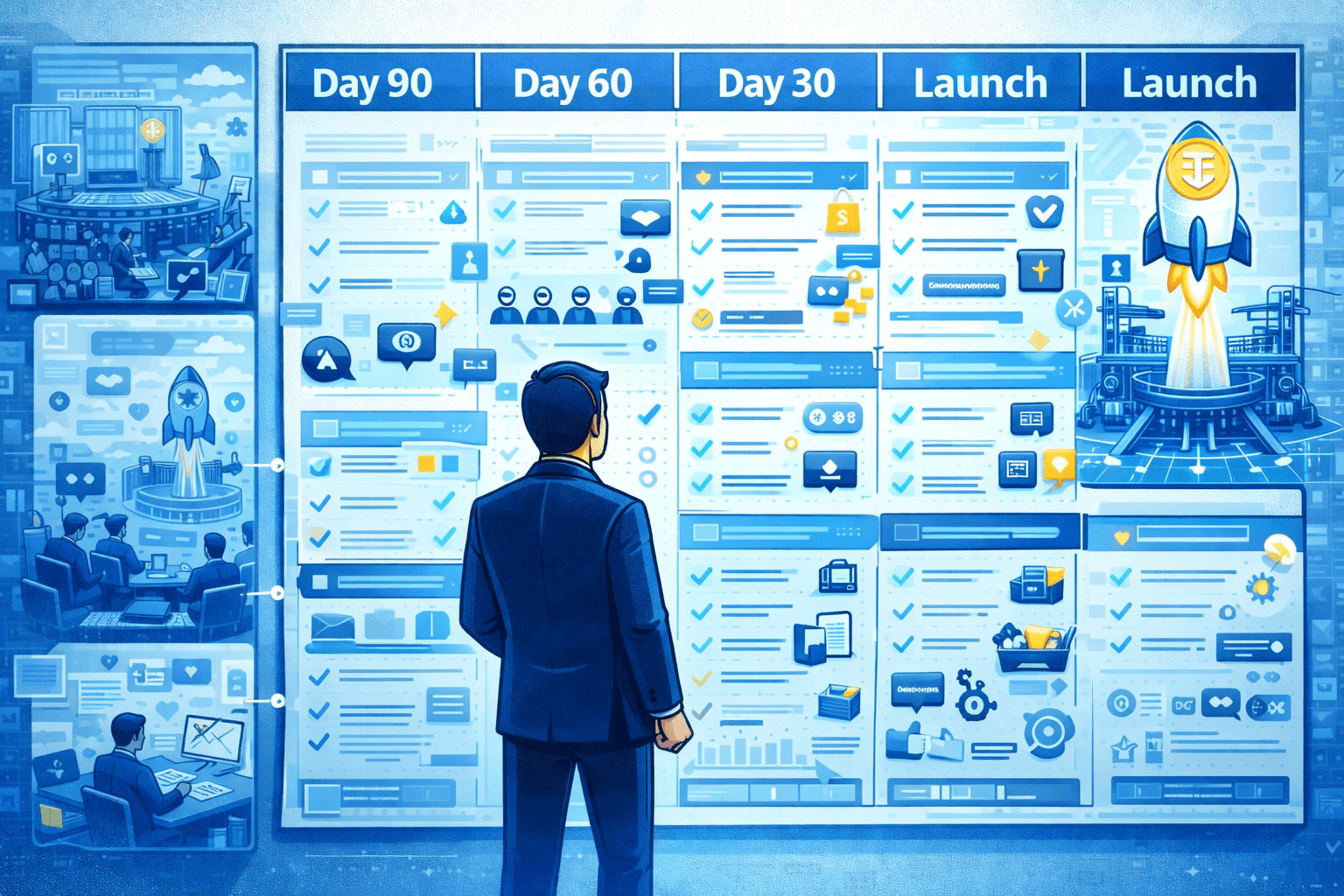
Phase 1: The 90 Days Before TGE (Pre-Launch)
The pre-launch window is where real token marketing happens. Everything you build here: your narrative, your community, your reputation, becomes the launchpad your TGE takes off from.
1. Lock In Your Brand Narrative Before You Talk to Anyone
Before you post a single tweet, run a single AMA, or brief a single KOL, your team needs to answer three questions with absolute clarity:
What problem does this token actually solve?
Who is the user, and why would they hold this token long-term?
What is the single line that makes someone stop scrolling?
It is the foundation for every piece of content, every influencer brief, and every community message will be built on. Projects that skip this step almost always end up with inconsistent messaging across channels and crypto users notice this immediately.
If you are working with a token marketing agency at this stage, the first deliverable you should expect from them is a messaging framework document, not a content calendar.
2. Build the Community Infrastructure
Most Web3 projects open a Telegram, drop a Discord invite, and call it community building. Actual community infrastructure looks different, it includes a moderation system that can handle 10x your current member count, a structured onboarding flow for new members, a content rhythm that keeps the channel active between big announcements, and a tiered ambassador or OG program that rewards early believers.
By the time you are 90 days from TGE, you should be targeting a minimum of 15,000-30,000 X followers, 10,000 active Telegram members and 5,000 Discord members as baseline credibility signals. These numbers matter not just for optics, exchange listing managers, launchpad committees, and institutional investors all look at community health as part of their due diligence.

3. Develop an SEO and Content Foundation
Organic search is the most underrated channel in Web3 token marketing. Your competitors are busy buying banner ads and sponsoring Spaces. Meanwhile, a well-structured blog targeting right keywords within your niche can start generating qualified, founder-level traffic within 60 to 90 days of publishing.
Aim to publish at least six to eight long-form articles before your TGE. Focus on bottom-funnel topics that bring in users who are already thinking about active participation in Web3 projects, purchasing tokens, but just don’t know where to start or what to choose. Each article should point to a lead capture mechanism, typically a registration or any other conversion indicator.
This is also where technical SEO matters. Make sure your site has clean metadata, proper semantics, and fast load times.
4. KOL Outreach and Influencer Brief Strategy
Key Opinion Leader (KOL) marketing in crypto works differently than traditional influencer marketing. Audiences are savvy, a generic, low-quality video from a mid-tier YouTuber does more damage than no video at all if it reads as paid promotion without genuine conviction.
The most effective KOL strategy at this stage is to identify 10 to 15 creators whose audience genuinely overlaps with your token's use case and offer them early access, meaningful context, and enough time to actually understand what you are building. A well-briefed KOL who creates authentic content three to four weeks before TGE is worth ten rushed posts from influencers who don’t understand your project’s context and record a video the night before without a brief.
Your briefs should include project background, key narrative angles, USP explanation, and specific talking points tied to the token's value proposition.
5. Launchpad and Exchange Partnership Groundwork
Launchpad applications, exchange listing conversations, and partnership announcements all have lead times that most first-time founders underestimate. Top-tier launchpads like Binance Launchpad, DAO Maker, and Polkastarter often require application submissions three to four months in advance. Even mid-tier launchpads typically need six to eight weeks.
Start these conversations no later than 90 days before your TGE. The marketing value of a confirmed launchpad partnership is significant, it functions as a credibility signal that unlocks press coverage, KOL interest, and community growth in ways that organic efforts alone cannot replicate.
Phase 2: TGE Week (Launch)
This is the week your entire pre-launch build pays off, or exposes its gaps.
6. Execute a Coordinated Multi-Channel Announcement
TGE day should feel like a coordinated event, not a chaotic rush of posts. Plan your announcement sequence in advance: a countdown series starting 72 hours before, a simultaneous announcement across Twitter, Telegram, Discord, and Medium at launch, and a live AMA or Spaces session within the first 24 hours.
Every piece of content published in this window should reinforce the same narrative. Your community managers, KOLs, ambassadors, and PR contacts should all be briefed with timing and key messages at least one week in advance.
7. Real-Time Community Management
The 48 hours after your TGE announcement will be the highest-traffic period your community has ever seen. Questions, FUD, technical issues, and genuine excitement will all arrive simultaneously. If your moderation team is overwhelmed or your response times are slow, that sentiment shapes first impressions for thousands of new community members.
Staff your community channels appropriately. Consider 24-hour coverage across time zones for at least the first 72 hours post-launch. Prepare an FAQ document for moderators covering the 20 most likely questions, token contract addresses, how to participate, vesting schedules, exchange listings.
8. Monitor On-Chain and Market Metrics Closely
Token marketing during launch week is not just outbound communication. Your team should be tracking token price action, wallet growth, liquidity depth, and social sentiment in real time. Unusual price movements, wallet concentration concerns, or coordinated FUD campaigns all require rapid, factual responses.
Projects that respond quickly and transparently to market events during their TGE build credibility, projects that go quiet tend to fill that silence with speculation.
Phase 3: 30 to 60 Days Post-TGE (Retention and Growth)
The post-launch phase is where most token marketing strategies completely fall apart. The pre-launch excitement has cooled, the KOL videos are a week old, and the hard work of building long-term token utility begins.
9. Shift From Acquisition to Retention
In the first 30 days after TGE, your primary job is to give existing token holders reasons to stay, that means regular ecosystem updates, product development milestones, and community events that reward participation rather than just speculation.
Staking mechanisms, governance participation, and ambassador programs are all effective retention tools, but only if they are communicated clearly and often. A weekly community update, even if brief, signals that the project is alive and shipping.
10. Pursue Strategic PR and Media Coverage
Post-TGE is actually the optimal window for many PR placements. Publications like CoinDesk, Decrypt, and The Block are more likely to cover a project that has successfully launched and demonstrated early traction than one that is still in the pre-launch hype phase.
Prepare a post-TGE press release highlighting your launch metrics: number of participants, funds raised, community growth, and any notable partnerships or exchange listings. Distribute it with a targeted outreach to crypto-focused journalists rather than mass press release distribution.

11. Track, Iterate, and Double Down on What Works
Every channel you used in your token marketing strategy should now have measurable performance data. Which KOL collaborations drove the most wallet sign-ups? Which content pieces generated the most strategy call inquiries? Which community events had the highest attendance?
Use this data to inform your next 60-day content and partnership plan. Projects that treat their token marketing as a learning loop, rather than a one-time campaign, tend to build the compounding visibility that leads to sustained secondary market demand.
Working With a Token Marketing Agency
Executing this entire 90-day framework in-house is possible, but it requires a dedicated marketing team with specific expertise across content, community, KOL relations, and PR. Many projects find that partnering with a specialized token marketing agency for at least the pre-launch and launch phases allows their core team to stay focused on product while ensuring marketing execution does not fall behind.
When evaluating agencies, look for teams that can demonstrate specific Web3 case studies, have existing relationships with relevant KOLs and media outlets, and approach your project with a strategy-first mindset rather than a service menu. A good agency will push back on your timeline if it is not realistic and tell you clearly what a successful launch requires, not just what you want to hear.
Conclusion
Token marketing is a special thing that includes many components. The projects that build meaningful, lasting traction after their TGE are almost always the ones that treated the 90 days before launch as seriously as the launch itself, and kept the work going through the noise of post-launch market dynamics.
Whether you are handling this internally or partnering with a token marketing agency, like Disence, the framework is the same: nail your narrative, build your community deliberately, execute your launch as a coordinated event, and keep showing up after the hype cycle fades.
If you want to talk through where your current token marketing strategy has gaps, or build a full 90-day plan from scratch, book a strategy call with the Disence team. We work exclusively with Web3 projects and have a specific practice around TGE marketing, KOL strategy, and organic growth.