How Concordium Is Emerging as Web3’s First Trusted Infrastructure

Need effective Web3 marketing?
Get on a free strategy call with Disence
We've helped 120+ Web3 teams launch effective KOL campaigns, build engaged communities, and acquire long-term users. Get 30 minutes of clarity without a pitch.
Book a free strategy call →No commitment · We usually respond within 24h.
As you look at how blockchain has changed over the last ten years, a few key ideas keep showing up: trust, privacy, compliance, and usability. These issues connect technology with real-world needs. Fixing them takes more than small tweaks or temporary fixes. It calls for a fresh approach to how blockchain functions at its core.
Concordium tackles this challenge in a different way. Instead of stacking compliance and verification tools on an existing Layer-1, it builds them straight into the core protocol. This creates a system that focuses on identity and protects privacy aiming to make it practical for real-world use.
Concordium has built this as the base of its advanced ecosystem, which is now starting to catch the attention of institutions and industries for potential collaborations.
Blockchain With Identity at Its Core
What sets Concordium apart from most Layer-1 networks is the unique structure it relies on. Each account ties to a verified identity, but that identity never shows up on the blockchain itself. Concordium achieves this using a well-organized network of Identity Providers and Privacy Guardians working together to maintain privacy and security.
When someone sets up an account, an Identity Provider confirms that they are a legitimate person or business. Instead of keeping personal information on file, the system provides a credential that stays with the user. Using this, the wallet can create zero-knowledge proofs, which let it answer things like “Is this person 18 or older?” or “Does this person reside in jurisdiction X?” without exposing any private details.
This approach allows apps to follow rules and regulations without managing delicate data while letting users stay in control of their own privacy. The design works not just for current Web3 platforms but also for the tightening compliance rules around online access, digital identity, and digital payments.
Privacy With Accountability
While Concordium emphasizes privacy, it also recognizes the need for legal accountability. The protocol’s design includes a secure, multi-party process that allows identity to be revealed only under a valid and approved legal request, and only through collaboration between authorized Privacy Guardians and the original Identity Provider. No single group is able to reveal a user's identity on its own.
Concordium’s approach ensures a balance where privacy is the default setting, but compliance happens when needed. This key principle shows a practical understanding of how blockchain must adapt to work within global laws and the existing financial system.
Predictable Fees: A Practical Solution for Real Usage
People who have used a blockchain during times of high market swings know that transaction fees can be all over the place. Concordium tackled this challenge from the ground up by bringing in a stable fee system tied to the euro.
Instead of letting fees change due to market shifts, the blockchain aims to keep costs steady in euros. It changes the required amount of CCD, the network’s token, to ensure it meets that specific value.
This approach takes the guesswork out for developers, businesses, and payment companies. Predictable fees make it easier to plan budgets, set consistent prices, and give users a more dependable experience.
A Product Ecosystem Designed for Real-World Use
Concordium’s technology works in real-world applications. Over the last year, the team released several products and integrations to show how the chain works .
Concordium ID App & Wallet Integrations
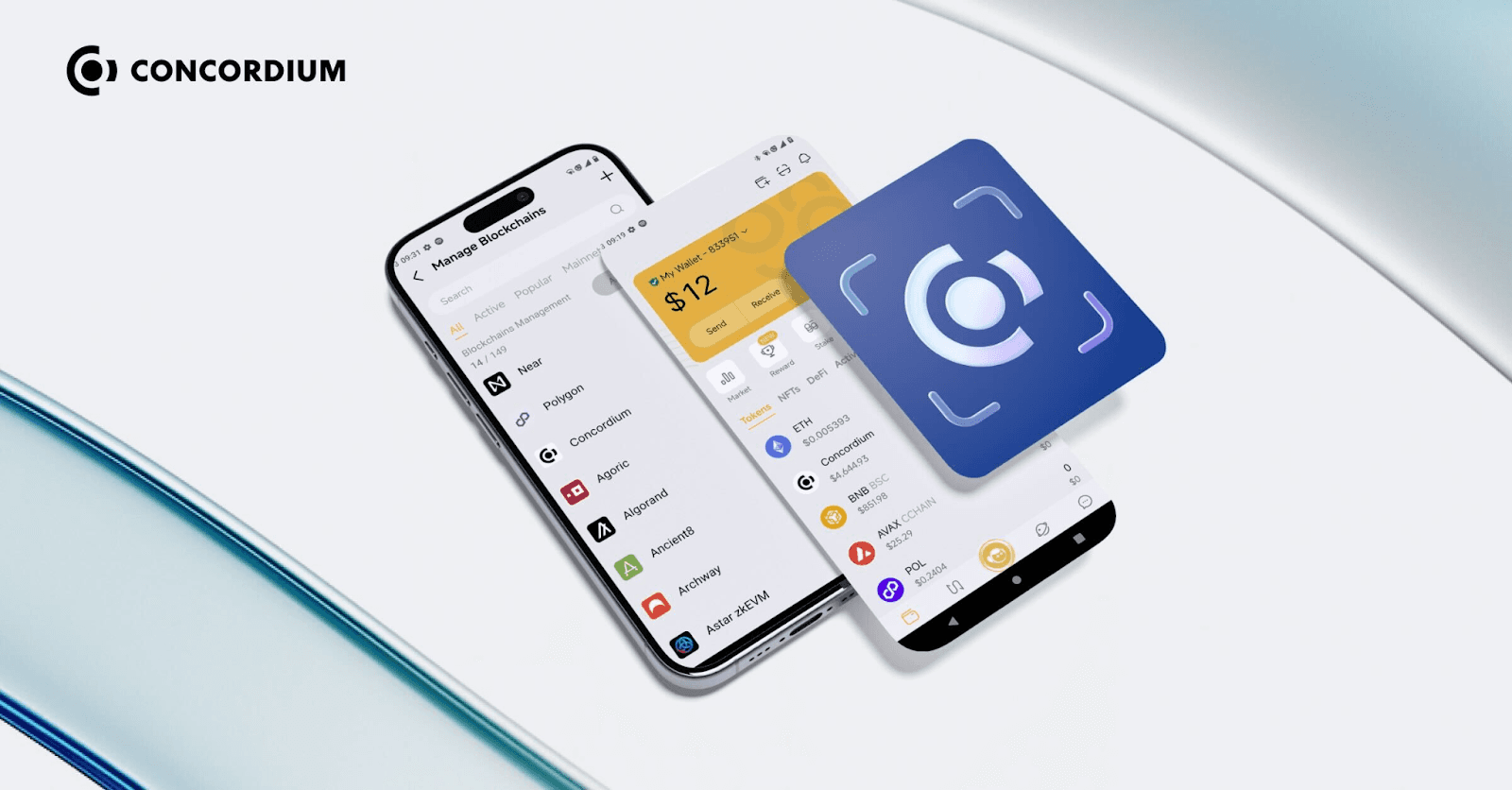
The Concordium ID App helps individuals perform privacy-focused age checks straight from their phones. Big wallet providers like Coin98 have supported Concordium right from the start adding its tools to a platform already serving over 10 million people. This lets millions of users set up Concordium accounts and do zero-knowledge age verifications in the wallets they are already using.
Protocol-Level Stablecoins
A significant step forward happened with the launch of 10 new stablecoins in five fiat currencies. In most ecosystems, stablecoins function as tokens based on smart contracts. Concordium takes a different approach by treating them as protocol-level assets. This design makes them easier to verify, safer to use, and better aligned with regulated payment systems and business-ready applications.
Verify & Pay
Concordium’s "Verify & Pay" feature demonstrates how identity-based payments work. Merchants can ask for a straightforward ZK proof, like verifying if a user is above 18. Once confirmed, the wallet processes the stablecoin payment in one step.
The merchant does not keep personal details, and users avoid sharing private information. This creates a checkout process built on trust, privacy, and rules, all done in just one step.
Verify & Access
Apart from handling payments, Concordium uses its identity system to let users access content. Sites, streaming services, and AI tools can ask for proof of access eligibility without needing accounts or extra documents.
This method matters more now as global rules like the EU Digital Services Act and the UK Online Safety Act bring in new age-check requirements.
Strategic Partnerships Strengthening the Ecosystem
Safe Payments to Millions With Ledger
One of Concordium's biggest collaborations is with Ledger, a top provider of hardware wallets. This partnership lets Ledger users take advantage of the “1-Click Verify & Pay” feature. By blending device-level security with identity features at the protocol level, this setup ensures safer and smarter transactions. From the start, this integration brings Concordium’s PayFi model to users all over the world.
New x402 Standard for On-Chain Web Payments
Concordium’s collaboration with x402, an open payment standard developed by Coinbase, positions the network at the center of a new era of programmable web payments.
x402 redefines the outdated HTTP 402 status code by turning it into a system that allows websites, APIs, and even AI-driven tools to request stablecoin payments while delivering zero-knowledge proofs of eligibility .
Concordium’s identity layer helps ensure these processes are smooth and compliant. It enables things like age-restricted content, location-verified access, pay-per-use APIs, and automated commercial transactions.
Institutional Partnership With Hilbert Group
Concordium reached an important point when Hilbert Group, a digital-asset company traded on Nasdaq First North, revealed a long-term stake in CCD.
Public companies need board approval, compliance checks, and thorough evaluations to invest. This shows that Concordium’s technology and plans passed a level of examination much stricter than what most early projects encounter.
Hilbert mentioned that CCD is their first investment in a token beyond Bitcoin and Ethereum. They also shared plans to keep adding more. While this doesn't count as an endorsement, it does suggest that Concordium has matured enough for institutional investors to take it.
Next Generation of Regulated Web3
As the gap between traditional digital platforms and Web3 apps continues to narrow, trust, privacy, and user-friendly compliance have become essential. Concordium positions itself as a creator of infrastructure designed for digital economies. These are the systems that regulators, businesses, and everyday users require rather than just chasing fleeting hype.
Concordium merges identity, privacy, fixed costs, and tailored integrations to create a platform businesses can rely on. Decentralization is not enough for many businesses, they also depend on stability.
Concordium’s journey focuses on consistent engineering, careful planning, and a strong grasp of what digital trust could look like in the future. Its growing ecosystem highlights how Layer-1 technology adjusts to meet practical needs while holding onto the main values of Web3.