Web3 PR in 2026: How Crypto Projects Get Tier-1 Media Coverage
Need effective Web3 marketing?
Get on a free strategy call with Disence
We've helped 120+ Web3 teams launch effective KOL campaigns, build engaged communities, and acquire long-term users. Get 30 minutes of clarity without a pitch.
Book a free strategy call →No commitment · We usually respond within 24h.
Every week, editors at CoinDesk, The Block, and Cointelegraph receive hundreds of pitches. Most are deleted in under 10 seconds, but not because the project is bad, because the pitch was built around what the founder wants to say, not what the journalist needs to publish.
This is the fundamental mistake in most crypto project media pitches, and fixing it is the backbone of an effective Web3 PR strategy. This article is for Web3 founders and token project teams who want earned editorial coverage, not sponsored placements, in tier-1 crypto and mainstream outlets.
Why Most Crypto Pitches Fail the Inbox Test
Crypto journalists in 2026 operate under higher editorial scrutiny than ever. Following the collapse of FTX and years of hype-driven coverage, editorial teams now apply a de-facto filter: "Can I defend why I published this to my editor?"
That means your pitch isn't evaluated on your project's merits alone, it's evaluated on newsworthiness.
Specifically:
Is this timely?
Is it verifiable?
Does it serve my audience's interest, or just yours?
The most common failure modes:
Announcements dressed as news: "We launched our testnet" is not a story. A $2M TVL surge in 72 hours after testnet launch is.
No third-party validation: A claim without an auditor, investor name, or on-chain data point is unverifiable, and unverifiable claims don't get published.
Pitching too early: Projects with no community traction, no users, and no on-chain activity give journalists nothing to anchor the story to.
The fix isn't a better press release. It's engineering your project's newsworthiness stack before you send a single email.
Step 1: Build Your Newsworthiness Stack First
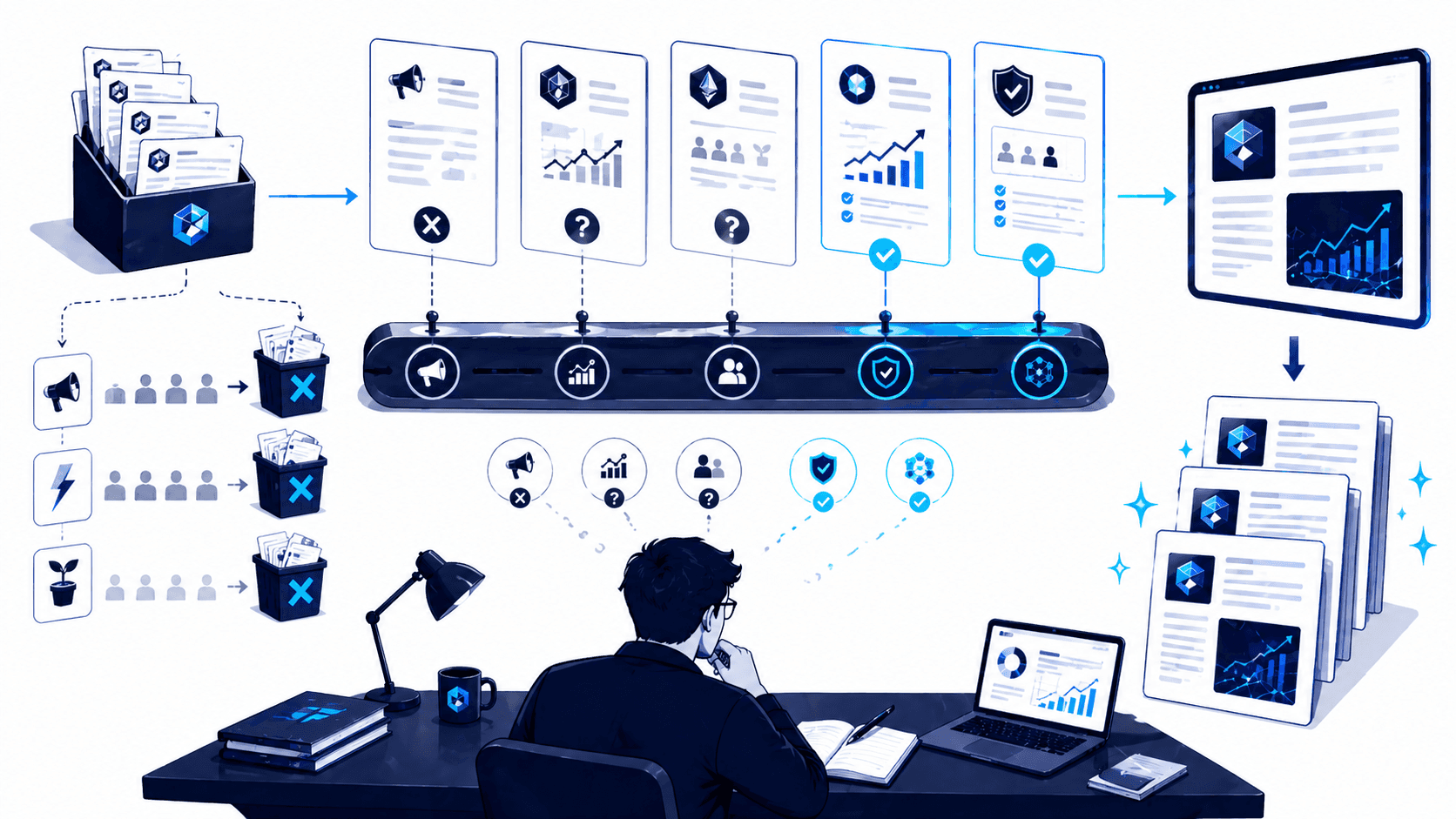
Journalists scan for three layers when deciding whether to pitch a story to their editor:
Timing: Does this connect to something already in the news cycle? (A new L2 protocol is more publishable the week after Ethereum's Pectra upgrade than in a quiet market.)
Data: Is there a number I can put in my headline? TVL, wallet growth, transaction volume, funding raised, concrete metrics are the currency of editorials.
Tension: What's the conflict, the contrast, or the counterintuitive insight? "Protocol solves X problem that costs DeFi $Y per year" is more compelling than "Protocol launches."
Before you start your crypto project media pitch, pressure-test your story against all three layers. If you can't pass all of them, you're not ready to pitch tier-1 outlets yet, and that's fine. Use that time to build the data.
Step 2: Use Community Traction as Editorial Proof
Here's an insight most Web3 PR guides skip: journalists pay attention to what their audience is already talking about.
If your project has visible traction on X (Twitter), Telegram, or through influential voices in your ecosystem, an editor can justify coverage with: "Our audience is already asking about this." That's a much easier internal sell than: "This team sent us a press release."
This is where KOL strategy and crypto media coverage intersect directly. Projects that have run coordinated KOL campaigns before pitching media arrive with proof, screenshots, engagement data, community conversations, that position the story as already newsworthy.
Practical steps:
Run a 2-4 week KOL activation phase before your media outreach push
Screenshot community discussions, tag volume, and sentiment data
Reference this traction explicitly in your pitch: "Following our recent community campaign, we saw 140+ creators discuss [protocol feature], generating 2.5M+ impressions organically"
This transforms your pitch from "please cover us" to "here's why your readers are already interested."
Step 3: Time Your Pitch Around Industry Moments
Timing arbitrage is one of the most underused levers in blockchain PR strategy.
Tier-1 outlets don't exist in a vacuum, they respond to market cycles, regulatory news, and ecosystem moments. A DeFi protocol launching cross-chain features the week of a major bridge exploit has a dramatically higher chance of coverage as a safety-focused alternative than it would during a quiet week. A staking protocol becomes more newsworthy the week after Ethereum validator queue data spikes.
Build a simple news calendar. Track:
Ecosystem upgrade schedules (Ethereum, Solana, Cosmos governance votes)
Regulatory announcements (SEC actions, MiCA implementation milestones)
Competitor events: their bad news is sometimes your story hook
Newsjacking – attaching your narrative to a breaking story, is one of the fastest ways to go from unknown project to quoted source in a tier-1 outlet.
Start small: offer a founder quote to a reporter covering a relevant story, even before pitching a standalone feature.
Step 4: The 5-Line Pitch Formula
Long pitches signal that you don't respect a journalist's time. Top crypto reporters receive 50-200 pitches per day. Your email should answer five things in five sentences:
The hook: What's the one surprising or timely fact about your project right now?
The data point: What verifiable number proves it?
The so-what: Why does this matter to this outlet's specific audience?
The credentials: One sentence on who you are (team background, backers, or traction).
The ask: Offer an exclusive briefing, data access, or founder interview, not just "please cover us."
The goal of the pitch email is to earn a reply, not to tell your full story. Save the full story for the briefing call.
Step 5: Sequence Your Media Outreach Strategically
Most Web3 teams make the mistake of going straight for CoinDesk or Bloomberg before they have the credibility to earn it.
A more effective sequence:
Tier-3 (crypto blogs, ecosystem media): Build a coverage trail and SEO-indexed mentions
Tier-2 (Decrypt, BeInCrypto, Blockworks): Establish credibility with crypto-native audiences
Tier-1 (CoinDesk, The Block, Bloomberg Crypto): Now you have references editors can verify
This sequencing is about giving journalists a search result. When a Bloomberg reporter Googles your project and finds 30 prior publications, the story already has social proof. When they find nothing, they're starting from zero trust.
This sequencing fits naturally within a broader token marketing strategy that coordinates PR timing with token launch phases, community growth, and liquidity events.
Where PR Fits in Your Overall Web3 Growth Strategy
The most effective Web3 PR strategies are integrated with KOL distribution, community growth, and GTM timing. A tier-1 feature that drops with no community amplification, no KOL coverage, and no social moment behind it will underperform its potential by 10x.
Think of PR as the credibility layer that makes every other channel work harder. A CoinDesk feature improves your cold email response rates, your investor due diligence outcomes, your KOL partnership negotiations, and your exchange listing conversations, simultaneously.
If you're evaluating how to structure this across your launch or growth phase, understanding what a Web3 marketing agency actually does, and how PR fits within that, will save you from a costly sequencing mistake.
If you want to build a PR strategy that's integrated with KOL campaigns, GTM timing, and sustainable token growth, talk to the Disence team, we work with projects that are ready to scale with proof.