How the SSV Network Transformed Ethereum Staking
Need effective Web3 marketing?
Get on a free strategy call with Disence
We've helped 120+ Web3 teams launch effective KOL campaigns, build engaged communities, and acquire long-term users. Get 30 minutes of clarity without a pitch.
Book a free strategy call →No commitment · We usually respond within 24h.
Ethereum staking has matured fast. Once a specialized task handled by individual operators, it is now a critical backbone for the network’s security and economic operations. However, as staking expanded, some significant structural flaws became evident.
To start, staking tends to create concentration. Big companies and large staking platforms might control a big chunk of the validators. Validator setups also face risk because they often depend on one machine, one key, or one team to function. Issues like downtime, bugs in the software, mistakes in configuration, or stolen keys are real dangers. These are the actual ways validators can fail when operating at a large scale. Decentralizing Ethereum’s consensus layer involves more than just having many validators. It is also about how those validators function and whether the system can run when parts of it fail.
This is the environment where SSV Network works, and its view is straightforward. To keep Ethereum strong over time, staking requires infrastructure that avoids single points of failure and makes decentralization more manageable.
As of now, SSV Network is the leading distributed validator technology (DVT) provider on the Ethereum network. Currently, the second-largest staking infrastructure by net penetration. The project claims 15% of all staked ETH runs on SSV, which equals more than 5.5 million ETH. This is backed by over 1900 node operators worldwide serving a range of users from individuals to large enterprises.

The main challenge with staking infrastructure
The foundation of staking comes down to basic principles, which involve one main requirement: the validator must sign messages, and the signing key must remain secure. In non-DVT or legacy setups, the private key is stored in one location (online with the node to sign duties). Considering that this approach works quickly, it still creates a risk environment. For example, if that system is hacked or stops working at a critical moment, the outcome might involve missed rewards, penalties such as slashing, or difficulties in maintaining everything. At scale, this could even disrupt the finality of the whole Ethereum network.
The broader industry has worked hard to address this issue by improving DevOps, strengthening key management, and implementing stricter operational rules. These efforts help, but they are not always sufficient. The difficult reality is that as validator operations expand, the impact of a failure also becomes larger. Staking needed a system where one mistake does not turn into a complete system breakdown.
What is DVT?
DVT, or Distributed Validator Technology, improves validator security by sharing key management and signing duties among multiple parties. This reduces single points of failure and makes the system more resilient.
SSV explains a simple concept: instead of keeping the validator’s full private key on one computer, DVT encrypts and divides it among several machines grouped into a cluster, allowing validator to do their work, while owners keep the private key in cold storage. Since no single computer has the complete key, it makes it much tougher for hackers to access it. Signing remains possible even if a few nodes are offline, making the validator more reliable during real-world issues like system crashes or temporary outages.
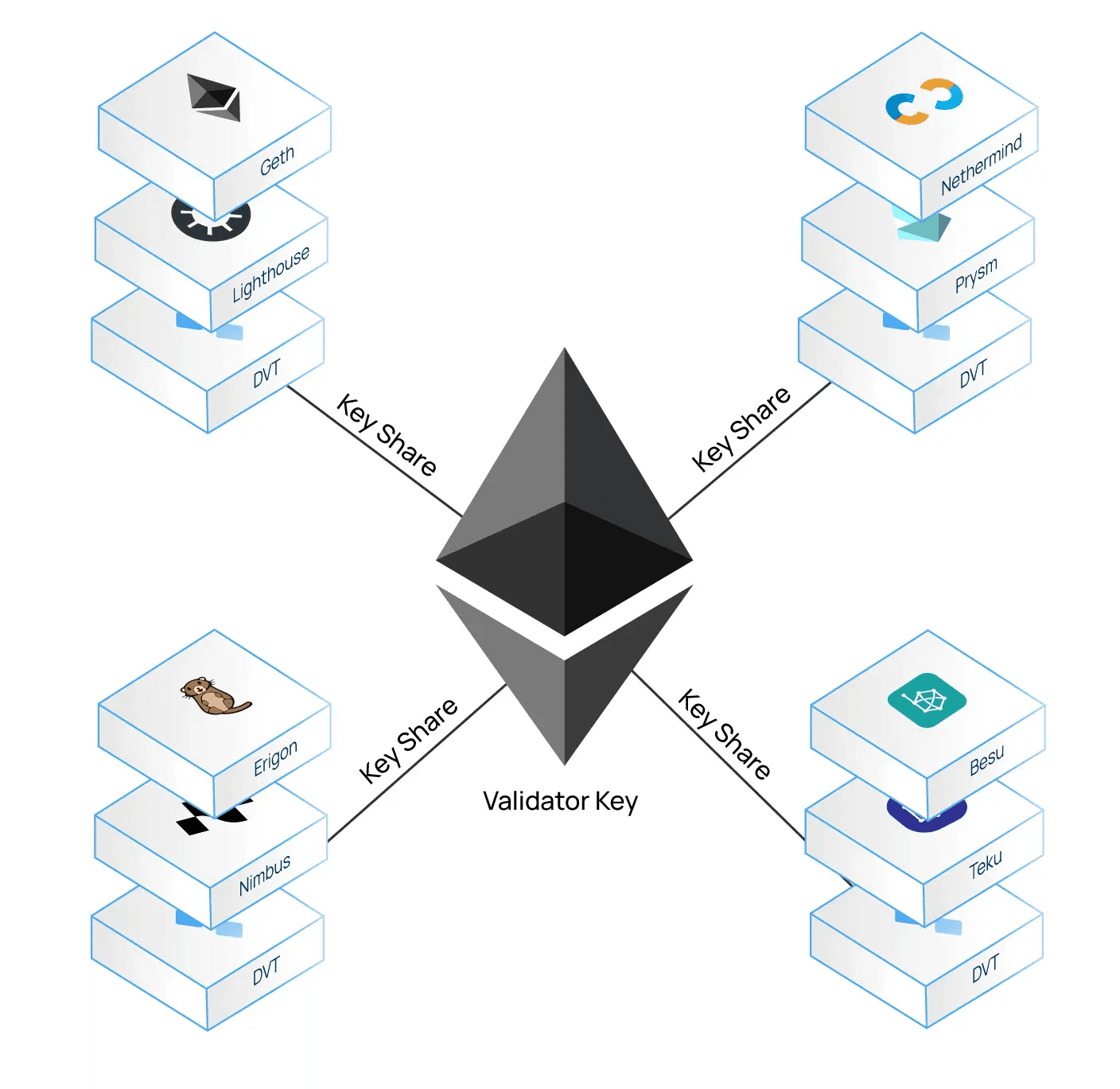
This is why SSV calls DVT the rising "gold standard" in staking in recent years.
A good way to think about it, from an engineering perspective, is that DVT tries to turn staking into something closer to fault-tolerant infrastructure. The goal is not to pretend failures will never happen. The goal is to design validator operations so failures are less frightening.
SSV Network and What Makes it Different
SSV Network describes itself as a protocol-agnostic infrastructure based on DVT, which anyone can use without needing permission.
Some staking projects focus on delivering services to consumers, like Ether.fi, Renzo. These services come with specific limits and features. SSV, on the other hand, focuses on infrastructure. It wants to be a foundational layer that many kinds of staking setups can connect to.
This includes individual stakers, staking service providers, and experienced operators. The project highlights its integration with key Ethereum staking networks like Lido where SSV technology has been built into frameworks such as SimpleDVT and CSM, which work with selected operator groups.
SSV emphasizes its growing use among professional node operators like P2P.org, Stakely, DSRV, Hashkey, and others. These operators use DVT as a tool to make their systems more decentralized and resilient.
To zoom out a bit, SSV suggests that Ethereum grows stronger when DVT becomes foundational infrastructure. This is not because every operator functions but because the network doesn't rely on any one operator achieving perfection.
Traction and Network Growth
Saying "we are infrastructure" is simple. Proving that the market views you as one is much tougher.
SSV boasts impressive stats despite having a short mainnet history. It secures over 5.5M ETH, powers 15% of all staked ETH, and has grown to include 1900+ node operators worldwide in just over two years on mainnet.
These numbers carry significance for several reasons:
They point out that SSV is more than just a niche experiment. People are using it at scale.
The variety of node operators strengthens the case for decentralization. The project highlights permissionless operators, from individuals to large businesses.
The growing role of staking infrastructure shows DVT is no longer a fringe architecture. It is becoming a regular part of staking setups.
SSV’s team is also working towards continuous ecosystem expansion. On their website, they’ve already highlighted over 60 partners building staking services and tools on top of the network, such as Allnodes, Ankr, Avado, blockshard and others. This is a strong indicator because infrastructure gains strength when it integrates well with others. Partners design their products based on certain assumptions, and those assumptions become part of lasting collaborations.
Key achievements and collaborations:
The milestones that SSV has achieved show how adoption is spreading through various levels of the staking market.
Over 60 ecosystem partners are creating tools and services for staking.
A P2P.org collaboration is boosting adoption among professional node operators.
The launch of Lido SimpleDVT integrates DVT into CSM and the curated operator network.
Partnerships with Ether.fi and Renzo highlight growing use in staking and related ecosystems.
Kraken moved its entire ETH staking operations onto SSV. It is the first major global CEX to adopt DVT, with others expected to follow.
SSV partners with Sigma Prime to develop a new node client.
Altogether, these ideas highlight how SSV Network works as a connective layer. Nor do crypto-native operator teams use it, but larger organizations and research-focused contributors are adopting it as well.
SSV Network’s Mission
SSV has a clear mission: to decentralize Ethereum’s validator set and secure the blockchain’s future.
This mission feels more like a technical goal than a marketing tagline. If Ethereum’s long-term value relies on its neutrality and strength, the consensus layer must avoid becoming dependent on centralized operations. The challenge goes beyond splitting up stake, it also requires spreading operational control and making the validator stack less fragile.
DVT represents exactly the SSV's effort to tackle that challenge.
What’s coming next for the project?
SSV plans to increase participation and make DVT a core part of the default staking process in the near future:
Bring SSV staking live on mainnet.
Introduce major CEXs and DEXs offering ETH staking.
Establish itself as the go-to infrastructure for institutional ETH staking.
The plan fits how infrastructure projects grow. First, they prove functionality. Next, they strengthen connections with big distribution platforms, and finally, they shape the system to align with institutional demands and standards.
Token and governance direction
SSV highlights a key protocol update. The SSV DAO shared a proposal to launch SSV staking, expected to begin in early March pending DAO vote. Along with protocol upgrades, the aim is to work toward making the SSV token function as an ETH accrual token.
The key point is that the team is connecting protocol participation, staking mechanics, and governance evolution under a single framework.
SSV Labs CEO (core contributor to SSV Network), Alon Muroch, explains the project’s path by emphasizing both the readiness of its infrastructure and the need to encourage wider involvement.
"SSV Network launched its mainnet a little over 2 years ago. Since then, it has shown that it plays a key role in Ethereum's infrastructure by decentralizing the consensus layer, one validator at a time. With the upcoming SSV Staking, we aim to let more people participate, not just ETH stakers. We want anyone to stake SSV and earn native ETH by helping secure important functions in the protocol, such as the new Effective Balance oracles, which are key to the accounting model for post-Pectra validators."
Even if you're not familiar with how protocols are designed, the idea is clear. SSV is shifting its focus from just infrastructure building to engaging more people in infrastructure participation through staking and securing core protocol functions, opening the door to more contributors.
Conclusion
When you look at Ethereum’s evolution, the most important changes tend to be the ones that improve resilience without breaking composability. DVT fits that pattern. It does not ask the ecosystem to abandon existing staking models. It asks staking models to become less fragile.
SSV Network’s current footprint, measured by the amount of ETH secured, the share of staked ETH running through its infrastructure, and the breadth of node operators and partners, suggests it has already crossed the line from “interesting idea” to “infrastructure that serious actors rely on.”
If Ethereum staking is going to remain credibly decentralized, it will need more than more validators. It will need better ways to operate validators. SSV’s bet is that distributed validator technology is one of those ways, and that the next year will be about making it the default.